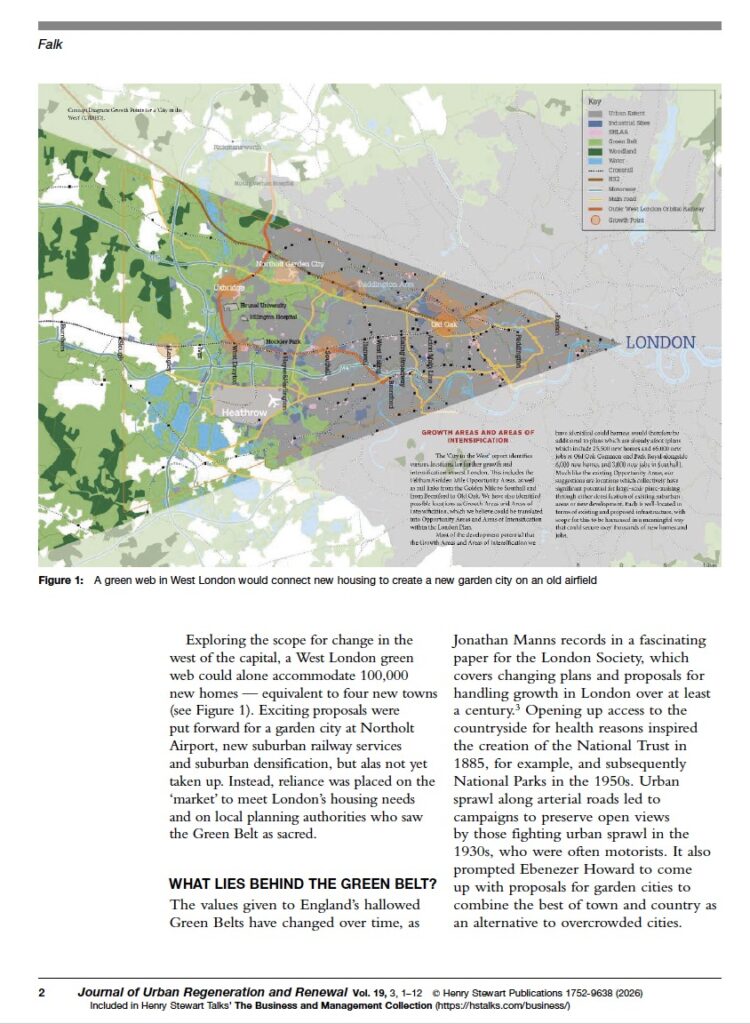
This paper calls for using green space to add value to developments rather than limit urban expansion as Green Belts have tried to do. It questions the importance of new towns as a means of providing the housing the UK needs to build and argues for urban extensions and renewal as better methods. Development corporations, as recommended by the New Towns Taskforce, should be used to implement spatial development strategies by assembling land and commissioning local infrastructure. The resulting uplift in land values can then be used to fund infrastructure improvements and new green space. A Common Wealth Fund should complement the National Wealth Fund by supporting local initiatives that conserve and improve the natural environment around town centres and railway stations.
Green Webs: Reshaping Green Belts as a route to smarter growth
Authors:
Dr Nicholas Falk
Published in:
Journal of Urban Regeneration and Renewal, Vol. 19, 3, 1–12
Date:
April 2026
Themes:
Economic growth and land management
Environment and sustainability
Locations:
Summary:
Reshaping Green Belts into 'green webs' can support smarter urban growth by connecting open land, water, and rail links. Urban extensions and renewal offer better housing solutions than new towns. Development corporations should assemble land and fund infrastructure through land value uplift, while a Common Wealth Fund can enhance local natural environments.
Ask a question of this publication
Our AI assistant has read this publication, so it can answer questions relevant to your area of interest. Try asking it a question, such as:
- What are the three main recommendations from this publication?
- What is this asking urban planners and policymakers to do differently?
- What problems and solutions are identified?
- Summarise this publication in 100 words
- What examples of good practice are given and what can we learn from them?
You asked
Ask a question above to see the response here
Disclaimer: The answers provided are generated by machine trained on the content of this publication, but may incorporate extraneous or inaccurate information. Please use your discretion and caution when interpreting these answers.