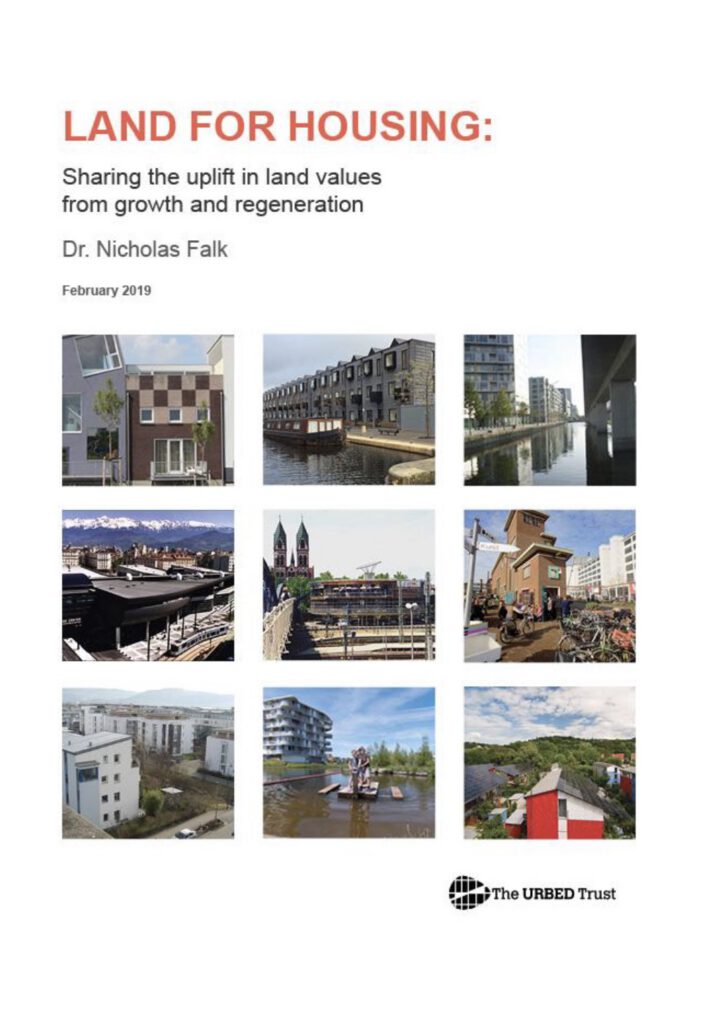
Where are the resources for building a better Britain to come from? This paper is a response to John Healey MP’s comprehensive report and consultation Housing for the Many, and specifically the proposal for an English Sovereign Land Trust to help assemble land needed for housing without paying an excessive price for it. The idea stirred up controversy at the time, and there was an invitation to submit other ideas. With growing public awareness of the need to mobilise land for housing, and very limited public resources, the next government needs a robust policy for sharing land value uplift, especially from development that benefits from public investment. Furthermore the benefits of such a policy need to be felt more widely, not just where property values are highest. This paper shows how the proposal can be made to work.
Land for Housing
Authors:
Dr Nicholas Falk
Date:
February 2019
Themes:
Economic growth and land management
Governance, policy, finance and community engagement
Locations:
Summary:
Britain's housing crisis and regional imbalances share a root cause: land value uplift is captured privately rather than reinvested locally. Drawing on seven European case studies - from Freiburg's self-build "passports" to Rotterdam's mutual benefit programmes - this report shows how Germany and the Netherlands turned land value capture into affordable housing, better infrastructure, and stronger local economies, all without relying on central government handouts. For policymakers, it offers a practical blueprint: freeze land prices in designated growth areas, empower development corporations with democratic mandates, and channel uplift into the transport and community infrastructure that struggling regions need - easing cost-of-living pressures while narrowing the North-South divide. This paper was prepared as a response to John Healey MP’s comprehensive report and consultation Housing for the Many
Ask a question of this publication
Our AI assistant has read this publication, so it can answer questions relevant to your area of interest. Try asking it a question, such as:
- What are the three main recommendations from this publication?
- What is this asking urban planners and policymakers to do differently?
- What problems and solutions are identified?
- Summarise this publication in 100 words
- What examples of good practice are given and what can we learn from them?
You asked
Ask a question above to see the response here
Disclaimer: The answers provided are generated by machine trained on the content of this publication, but may incorporate extraneous or inaccurate information. Please use your discretion and caution when interpreting these answers.